Why Choose WordPress?

WordPress logoPersonally, I researched for two years for a solid content management system (CMS) to host my 2,000 page static HTML site. I put many to the test with great frustration and wasted time as they were bulky, too complex, had frustrating interfaces, and high learning curve language as none of them spoke the same language, both in semantics and code. In fall of 2003, I kept stumbling across mention of this WordPress thing changing the whole concept of CMS, but it wasn’t called a CMS. It was called a blogging platform.

I tried and fell madly in love. It made sense. The interface was clean and simple and it was built on a simple dynamically generated HTML and PHP framework that I could easily incorporate into my existing award-winning design. By November of 2003, my site was relaunched on the six month old WordPress web publishing platform and I never looked back.

There are many reasons to choose WordPress, as many reasons as there are different types of enthusiasts for web design, development, and code.
Continue reading

What is WordPress?

WordPress logo is an open source publishing platform for the web. It allows easy content management and publishing via the web browser to the web. There are four versions of WordPress.

WordPress – Self-Hosted Version

, the self-hosted version of WordPress, is often called “dot org” or “full version.” It is the version of WordPress used by those with paid hosting services or “self-hosted.”

The is the most flexible of the WordPress versions as the user can choose from any WordPress Theme and customize it fully or create their own, and add any WordPress Plugin, script or custom code to their site. The self-hosted version of WordPress can be used by beginner or expert.

This version is appropriate for any individual or company. Continue reading

How WordPress Boots Up: A Step-by-step Examination of the WordPress Loop

Theme.fm has a series of three articles on how WordPress boots up, how it moves through the process as a visitor lands on their first page on your site and a step-by-step look at the WordPress Loop.

  1. WordPress Internals: How WordPress Boots Up
  2. WordPress Internals: How WordPress Boots Up Part 2
  3. WordPress Internals: How WordPress Boots Up Part 3 – Theme.fm

As a visitor lands on a web page on a WordPress site, the browser begins the process of loading the visitor request to view a specific page. On that web page, there are codes that instruct WordPress to pull information from the site design files called WordPress Theme template files, from WordPress Plugins, from the database, and other code requests to literally build a viewable page instantly for the visitor. These articles dig deeply into how WordPress code works with all the various programs and options to generate that page.

Creating a Social Marketing Strategies Map

The following are discussions and examples of creating a social media marketing strategies map.

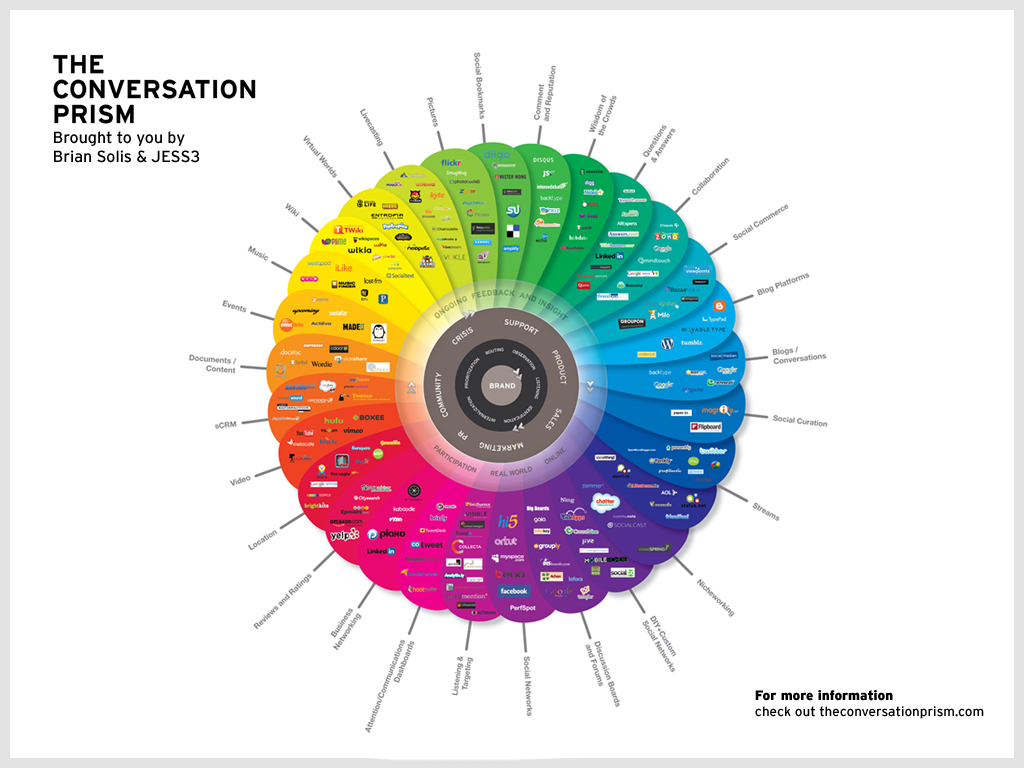
The Conversation Prism by Brian Solis and Jesse Thomas

Conversation Prism by Brian Solis and Jesse Thomas v3

The Conversation Prism by Brian Solis and Jesse Thomas was one of the earliest models for helping to visualize the conversations that define the social web.

Created originally in August of 2008, it has been updated several times as social media networks and trends have changed.

The prism chart is a bit hard to see on a web page, so let’s break it down into digestible parts.

Inside the Chart

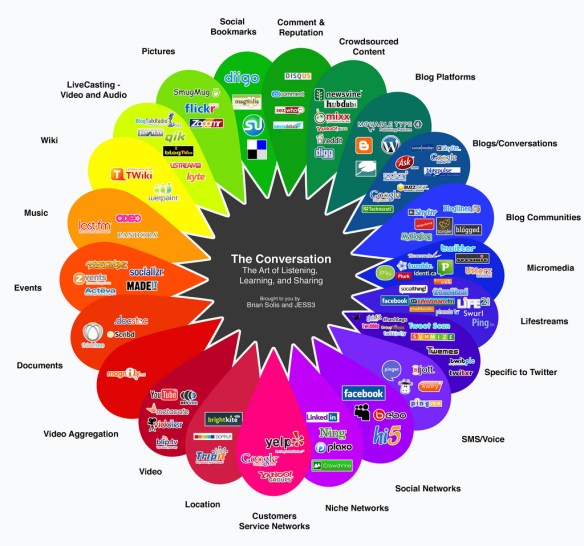
conversation prism by brian solis and jesse thomas v2The original version one and two of the Conversation Prism spelled out strategies for business communication and the social web. It bears highlighting as part of our conversation on marketing within the social web.

Version 3, shown at the top, removes the center strategies, focusing totally on listening. Many businesses don’t “get” what listening really means when it comes to the social web.

The Brand is the core of the circular chart representing the end goal: marketing the brand. From this, all things branch out as the goal must be served by the actions within the social web.

Wrapped around the inner Brand circle is a ring, called a halo, listing: Observation, Listening, Identification, Internalization, Prioritization, and Routing. These are the definitions of observing, listening, or participating in social media.

The next halo represents the “intersection of all public facing departments,” which is the business departments or titles to create a social media Customer Relationship Management (CRM) strategy. They include Customer or Product Support, Product and Sales, Marketing/PR, Community, Corporate Communications, Crisis, and Support.

Halo three is described as the completion of the conversational workflow powered by “continual rotation of listening, responding, and learning online and in the real world.” It is represented by ongoing feedback and insight, participation, online and real world relationships and communication.

The outer part of the circle highlights the specific social media services sorted by subject matter and interest such as Questions and Answers found through Quora and LinkedIn, and Wikis with Wikipedia, TWiki, Wika, and other wiki-based sites and services.

This chart and others are available through The Conversation Prism Store.

US Air Force Web Posting Response Assessment

Air Force Web Posting Response Assessment v2

Source: Air Force Web Posting Response Assessment (PDF)

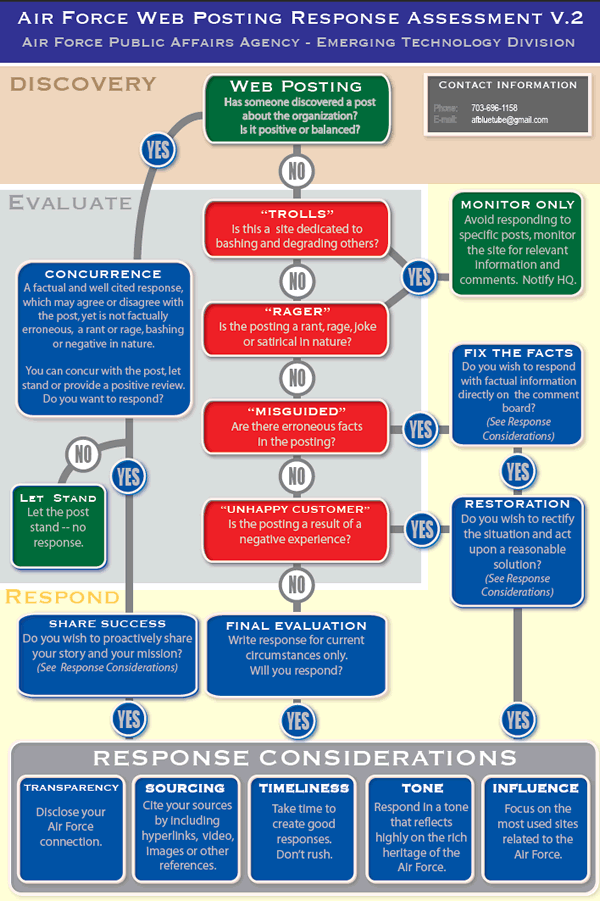
The Air Force Web Posting Response Assessment was created by the Air Force Public Affairs Agency’s Emerging Technology Division to create a flow chart path for responding to comments in social media and blogs. While designed for blogs and blog comments, it works across all social networks and online and off-line communications. It’s caught the attention of the social media industry as a solid strategy that businesses should consider when training their staff handling web communications and marketing and establishing clear communication guidelines.

The chart is divided into four areas: Discover, Evaluate, Respond, and Response Considerations. In reality, it covers three areas, Discovery, Evaluation, and Response, as Response Considerations are part of the evaluation.

In general, the chart explains comment responses:

  1. Before responding, consider the source of the response and their attitude and objectives.
  2. Decide how to respond based upon the attitude and objectives of the commenter.
  3. Write the response in consideration of tone, influence, timeliness, transparency, and sourcing (justification and evidence).
  4. Evaluate response and continued conversation, if any, for future considerations and actions.

Among the response options are to monitor only (let the comment stand but take no immediate action), respond with facts to fix the commenter’s falicies or support the original position, respond with a solution to rectify the situation and restore calm and reasonable perspectives, and to reinforce your position positively by “sharing success” and restating your story and mission.